
Your CCTV Is Recording, But the Wrong Lens Could Cos
The cameras were working. The incident was recorded. However, the person’s face is unclear, the vehicle’s number plate cannot be read, or the important activity happened outside the camera’s field of view.
This is a common frustration for businesses, residential developments and institutions across Kenya. The problem is not always the camera quality. In many cases, the wrong lens was selected.
What Happens When the Wrong Lens Is Used?
A CCTV camera may record an incident without providing useful evidence. Poor lens selection can result in:
- Faces appearing too small or unclear
- Vehicle number plates being unreadable
- Cash transactions lacking sufficient detail
- Important areas remaining outside the camera’s view
- Wide coverage with limited identification detail
- Narrow coverage that creates unexpected blind spots
- Footage that cannot adequately support investigations
- Additional costs to reposition or replace cameras
The key question is not simply, “How many cameras do we need?” It is, “What must each camera clearly capture?”
Understanding CCTV Lens Sizes
The lens determines how wide an area the camera can see and how much detail it captures at a given distance.
A smaller lens provides wider coverage, while a larger lens provides a narrower but more focused view. Actual viewing angles may vary depending on the camera model, sensor size, mounting height and installation conditions.
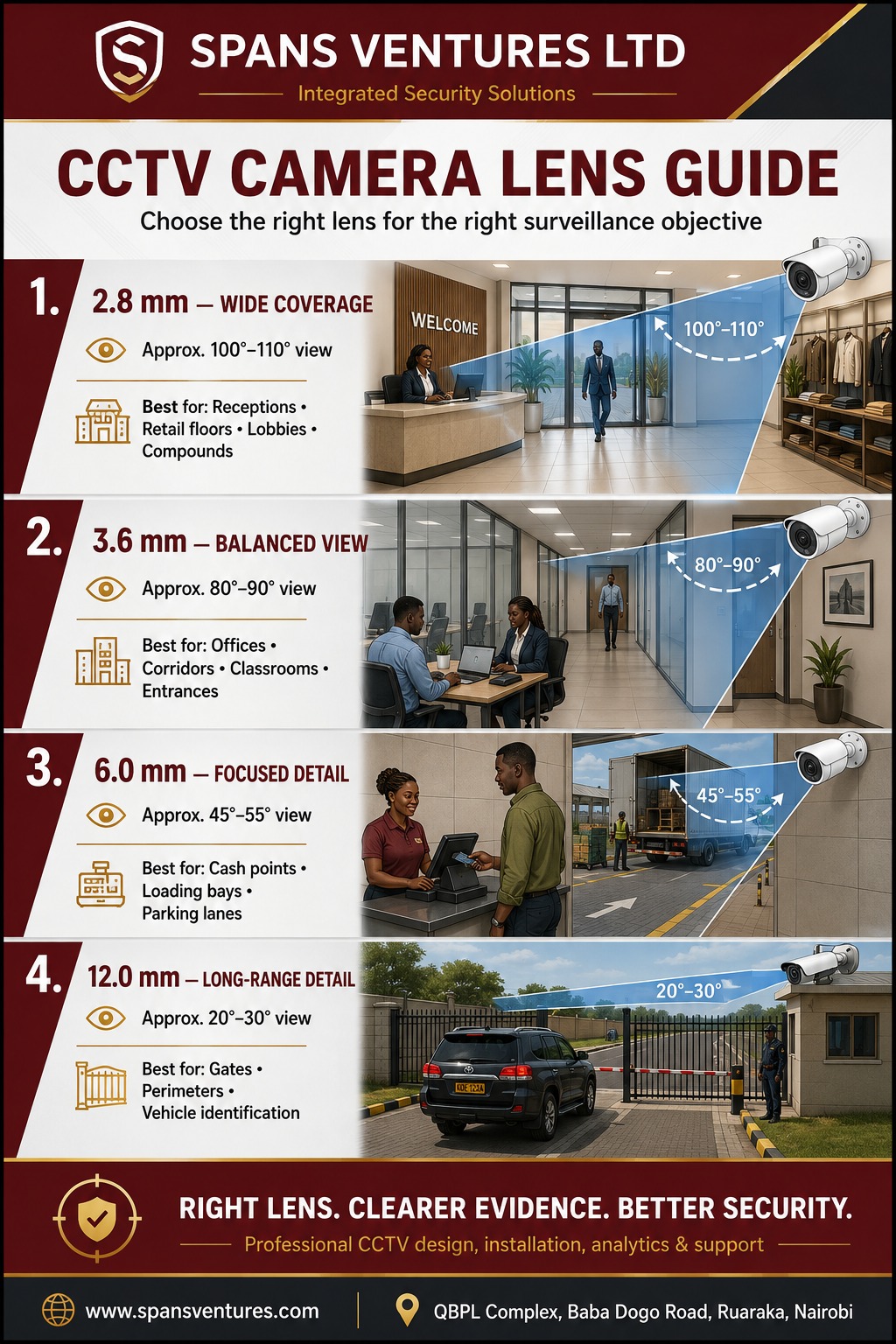
2.8 mm Lens: Wide Coverage
Provides an approximate viewing angle of 100°–110°.
Suitable for:
- Receptions and lobbies
- Retail floors and supermarkets
- Residential compounds
- Churches and social halls
- Open-plan offices
- Small warehouses
It is ideal for general observation, but people and objects farther from the camera may appear too small for reliable identification.
3.6 mm Lens: Balanced Coverage
Provides an approximate viewing angle of 80°–90°.
Suitable for:
- Office corridors
- Apartment entrances
- Classrooms
- Hospital corridors
- SACCO and banking halls
- Building access points
It offers a practical balance between area coverage and image detail.
6.0 mm Lens: Focused Detail
Provides an approximate viewing angle of 45°–55°.
Suitable for:
- M-Pesa and cash-handling counters
- Supermarket tills
- Loading bays
- Parking lanes
- Warehouse aisles
- Restricted access points
It captures better detail within a specific area, but poor positioning can leave nearby activities outside the camera’s view.
12.0 mm Lens: Long-Range Detail
Provides an approximate viewing angle of 20°–30°.
Suitable for:
- Estate and apartment gates
- Factory entrances
- Perimeter boundaries
- Long driveways
- Parking entry and exit lanes
- Vehicle identification points
For reliable number-plate capture, a dedicated ANPR camera is normally recommended. It is designed to manage vehicle movement, reflective number plates, headlight glare and changing lighting conditions.
Seeing Is Not the Same as Identifying
A camera may show that someone entered your compound without capturing a clear face. It may also show a vehicle passing through the gate without recording a readable number plate.
Before selecting a lens, establish whether the camera is intended to:
- Monitor general activity
- Detect intrusion
- Recognise staff, residents or visitors
- Provide clear facial identification
- Monitor cash transactions
- Identify vehicles
- Capture number plates
- Provide evidence for investigations
Each objective requires the right combination of lens size, camera resolution, distance, mounting position and lighting.
The Cost of Getting It Wrong
When the wrong lens is installed, the weakness may only become apparent after an incident.
The footage may not assist management, the police or insurers. Existing cameras may need to be replaced or repositioned, while additional cabling and installation work increases the overall cost.
The greater loss may be the inability to identify an offender, verify a transaction, trace a vehicle or understand how an incident occurred.
Get the Design Right Before the Incident Happens
A professional CCTV site survey helps determine the risks, required camera positions, appropriate lenses, possible blind spots, night-time conditions, storage requirements and power protection.
At Spans Ventures Ltd, we design CCTV systems around the specific risks and operational requirements of each premises. Our services include:
- CCTV site surveys and system design
- Camera and lens selection
- Supply and professional installation
- Intelligent video analytics
- ANPR and vehicle identification
- Remote monitoring
- Recording and storage solutions
- Integration with access control and visitor management
- Preventive maintenance and technical support
Do not wait until an incident occurs to discover that your cameras were watching but could not provide the evidence you needed.
Right lens. Clearer evidence. Better security.
Contact Spans Ventures Ltd
Telephone: +254 713 801 302 / 020 252 5114
Email: info@spansventures.com
Website: www.spansventures.com
Office: QBPL Building, off Baba Dogo Road, Ruaraka, Nairobi
Postal address: P.O. Box 11931–00100, Nairobi, Kenya